EPOXY VS POLISHED CONCRETE
Epoxy is a coating that goes on top of the slab. Polished concrete is the slab itself, ground back and honed until it shines. They look different, cost differently and fail differently — and for a garage the answer is usually epoxy.
Both start the same way, with a full mechanical grind. What happens after that is where they part company.
Written by the crew who do the work · 20+ years on Brisbane slabs · QBCC/BSA 1109935
Last updated 29 July 2026
Coating vs slab
ONE IS A COATING, ONE IS THE SLAB
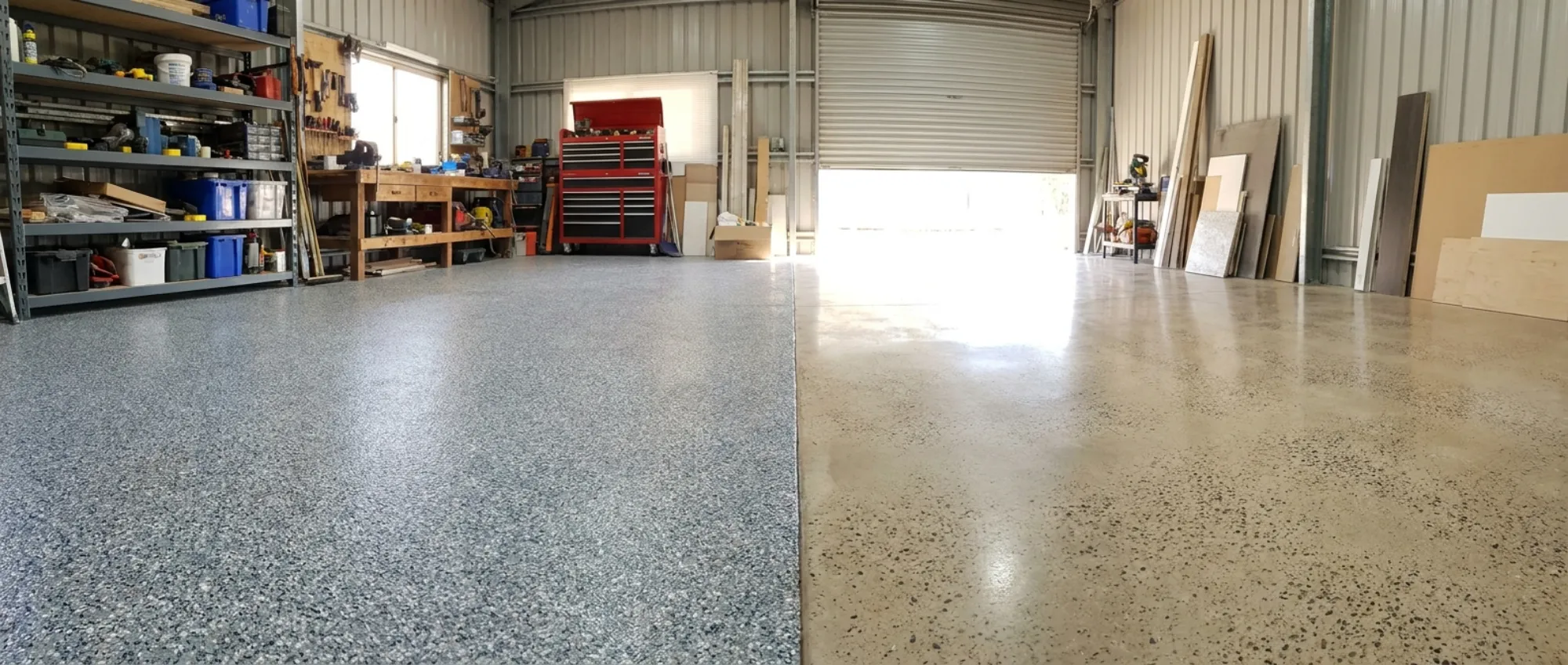
With epoxy we grind the surface open, repair it, then build a new surface on top — pigmented base coat, flake broadcast into it, then two clear coats. What you walk on is the coating, and its colour and pattern are chosen from a chart.
With polishing there is no new material. We cut into the slab you already have and refine it up through the grit sequence until it shines. What you get is whatever is inside your concrete — cream, salt-and-pepper or full stone — so the finish is decided by the pour, not a colour chart.
| Epoxy flake | Polished concrete | |
|---|---|---|
| What you walk on | A coating built on the slab | The slab itself, honed |
| Colour choice | Any colour, any flake blend | Whatever the slab contains |
| Chemical and oil resistance | Excellent — it is a barrier | Good once sealed, but porous by nature |
| Hot tyre pickup | Not an issue when ground properly | Not applicable |
| Wet grip | Anti-slip additive available | Can be slippery at high gloss |
| Repairs | Patch and re-coat | Re-grind the area |
| Time on site | About 2 days | 2–4 days depending on area |
| Best for | Garages, workshops, commercial | Interiors, alfresco, showrooms |
The common case
FOR A HOME GARAGE, EPOXY WINS
A garage slab is rarely worth polishing. It was poured as a utility floor, it usually has a trowelled cream finish with nothing interesting underneath, and it spends its life under hot tyres, oil drips and dropped tools.
Epoxy handles all of that and lets you pick the look. The one thing that matters more than the product is the preparation: a floor that was acid-washed instead of ground is the floor that peels at the roller door in two summers.
- +Full diamond grind and moisture test before anything goes down
- +Epoxy mortar into cracks and joints, ground flush
- +Flake broadcast to refusal, then scraped and vacuumed
- +Two clear coats — polyaspartic when it has to go back into service fast
- +Anti-slip additive where the floor gets wet
Inside the house
FOR LIVING AREAS, POLISHING USUALLY WINS
Inside a new build, the slab is often worth showing. Polishing gives depth that a coating cannot fake, it never peels because there is nothing to peel, and it takes underfloor heating and heavy furniture without complaint.
The decision that matters is cut depth. Cream exposure barely goes below the surface; salt-and-pepper cuts further; full stone exposure deeper again. Every slab exposes differently, so we grind a test patch in your own floor and agree the look before running the whole area.
The short version
HOW TO CHOOSE IN THIRTY SECONDS
Pick epoxy if the floor is a garage, workshop or anywhere chemicals get spilled, if you want a specific colour, or if the slab underneath is nothing to look at.
Pick polishing if the floor is inside the house or under the alfresco, if you want the concrete itself to be the finish, and if you are happy to let the slab decide the character.
If you are not sure, we will grind a small test patch and you can see what your slab actually holds before you commit either way.
Straight answers
COMMON QUESTIONS
Still not sure? Ring us and describe the slab — you will get a person, not a message bank.
ASK US — 0404 859 045
Is epoxy or polished concrete cheaper?
For a standard home garage they land in a similar range, because both start with the same full mechanical grind. Polishing gets more expensive as the gloss level climbs, since each step up means another pass through the grit sequence.
Which is better for a garage floor?
Epoxy, in almost every case. It resists oil, chemicals and hot tyre pickup, and it lets you choose the colour rather than accepting whatever is inside a utility slab.
Is polished concrete slippery?
Dry, no. Wet, a high-gloss finish can be — so for alfresco areas and anywhere near water we either stop at a lower gloss or use a seal with grip in it.
Can you polish an existing garage slab?
Often, yes. What we cannot do is polish a slab that is badly out of level or has had tiles, glue or a topping over it, without first agreeing how deep we need to cut.
How long does each take?
Epoxy is about two days on site, with foot traffic after 24 hours and vehicles after roughly 72. Polishing is two to four days depending on area and gloss level.
WANT TO SEE WHAT YOUR SLAB HOLDS?
We will grind a test patch in your own floor and show you the difference in person before you commit to either.