CONCRETE RESURFACING VS REPLACING
Resurfacing costs roughly a third to a half of what removing and re-pouring costs, and it is finished in days instead of weeks. The catch is that it only works on a slab that is structurally sound — so the honest answer depends entirely on what is under your feet.
We quote both, so we have no reason to push you one way. What follows is the same assessment we run on a driveway before we price it.
Written by the crew who do the work · 20+ years on Brisbane slabs · QBCC/BSA 1109935
Last updated 29 July 2026
The numbers
WHAT EACH ONE ACTUALLY COSTS YOU
Resurfacing avoids the expensive parts of replacement: there is no excavator, no spoil to cart away, no new formwork, no concrete pump and no 28-day wait for a fresh slab to cure. You are paying for preparation, material and labour on a surface that already exists.
Replacement buys you a brand-new structural slab with a fresh service life. If the existing one is failing, that is not a luxury — it is the only thing that will last.
| Resurfacing | Replacing | |
|---|---|---|
| Relative cost | Roughly a third to a half of replacement | The full cost of demolition and a new pour |
| Time on site | 2–3 days for a typical driveway | 1–3 weeks including cure time |
| Disruption | No excavator, no spoil, no heavy plant | Excavation, truck access, spoil removal |
| Before you can drive | 5–7 days | 28 days for full strength |
| Finish options | Any pattern and colour in the range | Plain, broom or exposed aggregate |
| Fixes structural faults | No — it is a surface, not a slab | Yes — that is the point |
| Expected life | 15–20 years with re-sealing | 30–50 years |
Green light
WHEN RESURFACING IS THE RIGHT CALL
The slab has to be sound. That means it sits still, it drains, and any cracking in it is cosmetic or dormant rather than a symptom of the ground moving underneath.
- +Surface is stained, faded, chalky or just dated
- +Hairline, shrinkage or dormant settlement cracks
- +Spalling or pitting in the top few millimetres
- +The slab still sits level and drains the right way
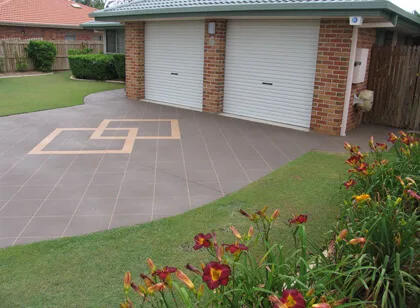
- +You want a pattern or colour a plain slab cannot give you
- +You want it done in days, not weeks
Red light
THE FOUR FAULTS THAT MEAN REPLACE
If any of these are present, an overlay is money thrown away — it will telegraph the fault back through within a season or two, and you will pay twice.
- +Heaving. The slab is lifting, usually from reactive soil or a tree root.
- +Lost base. Water has washed out the material under the slab and it rocks or drums when you walk it.
- +Independent movement. The slab has broken into sections that move separately from each other.
- +Structural cracking. Wide, growing cracks with vertical displacement across them.
On the driveway
HOW WE ASSESS YOUR SLAB
We walk it, sound it, look at the crack pattern and check the falls. Crack width and whether the two sides sit level tells us most of it — a hairline you can barely catch a fingernail in is cosmetic, a 5mm crack with one side sitting proud is structural.
We also moisture-test where it matters. A damp slab changes the primer and sealer, and finding that out after the coating has gone down is how failures happen.
Then we tell you which one your slab needs, in writing. If it is replacement, we will say so — we would rather lose the resurfacing job than warrant work that was never going to hold.
Straight answers
COMMON QUESTIONS
Still not sure? Ring us and describe the slab — you will get a person, not a message bank.
ASK US — 0404 859 045
Is concrete resurfacing cheaper than replacing?
Yes — generally a third to a half of the cost of removing and re-pouring, because there is no excavation, no spoil removal, no formwork and no new concrete. It is also finished in days rather than weeks.
How long does resurfaced concrete last compared to a new slab?
A properly prepared overlay lasts 15 to 20 years and more with re-sealing every 3 to 5 years. A new slab has a 30 to 50 year structural life. The overlay is a surface, not a structure — but on a sound slab it outlasts most people’s ownership of the house.
Can you resurface over a cracked driveway?
Cosmetic and dormant cracks, yes — they are cut out, filled and stitched first. Live structural cracking, heaving or a slab that has lost its base cannot be resurfaced honestly; those need replacing.
Will the old cracks come back through the new surface?
Not if the crack was dead and prepared properly. A crack that is still moving will always telegraph through eventually, which is why we assess movement before we quote a finish.
Do I need council approval to resurface my driveway?
Not for the section on your own property. Work on the crossover between the kerb and your boundary is council-controlled, and we build those to council spec and leave them inspection-ready.
NOT SURE WHICH ONE YOUR SLAB NEEDS?
We will come and assess it for nothing and tell you straight — including when the honest answer is replacement rather than the job we would rather sell you.